Looking for similes for poor? You can describe poverty and financial hardship by comparing limited resources to an empty cupboard, a dry well, a fading candle, or a garden struggling without rain. These comparisons help readers understand what it means to have little money, few resources, or difficulty meeting everyday needs.
This collection includes 45 similes for poor, each with a meaning and an example sentence. Some are simple enough for students, while others are more descriptive for stories, poems, and essays. The examples focus on financial circumstances rather than making negative judgments about people experiencing poverty.
Quick Answer: What Is a Simile for Poor?
A simile for poor compares financial hardship or having very little money to something familiar using words such as like or as. For example, “His wallet was as empty as a dry well” suggests that he had no money available. Other comparisons, such as a cupboard with few supplies or a candle nearing its end, can describe limited resources in creative writing.
What Does Poor Mean in a Simile?
The word poor can describe someone who has little money or insufficient resources to meet their needs. It can also describe something that is lacking in quality, strength, or quantity.
In this article, poor refers mainly to financial hardship, limited resources, and difficult economic circumstances.
A simile makes this idea easier to picture by comparing it with something familiar.
For example:
“The family’s savings were as thin as a sheet of paper.”
This comparison suggests that the family had very little money saved. The image of thin paper helps readers understand how limited their financial resources were.
When writing about poverty, it is important to distinguish between describing a difficult situation and judging the people experiencing it.
45 Similes for Poor
These examples are organized into meaningful categories to help you choose the right comparison for a story, poem, school assignment, or descriptive paragraph.
Simple Similes for Poor
These straightforward comparisons are suitable for students, beginners, and everyday writing.
1. As poor as a church mouse
Meaning: Having very little money or almost no possessions.
Why it works: A church mouse is traditionally imagined as a small creature with limited access to food and resources.
Example sentence: After paying his bills, he felt as poor as a church mouse.
2. As empty as a dry well
Meaning: Having no money or very few financial resources.
Why it works: A dry well contains no water, making it a useful image for something that has been completely depleted.
Example sentence: Her wallet was as empty as a dry well after the unexpected expenses.
3. As bare as an empty cupboard
Meaning: Having very few supplies, possessions, or necessities.
Why it works: An empty cupboard creates a clear picture of limited resources.
Example sentence: By the end of the month, their cupboard was as bare as an empty cupboard.
4. Like a pocket without a penny
Meaning: Having no money available.
Why it works: A pocket is normally a place to keep money, so imagining it without even one penny emphasizes the lack of cash.
Example sentence: He walked into the store with a pocket like a pocket without a penny.
5. As thin as a paper wallet
Meaning: Having very little money to spend.
Why it works: A thin wallet suggests that there are few bills or other items inside.
Example sentence: Her budget was as thin as a paper wallet after the rent was paid.
6. Like a cupboard with one lonely can
Meaning: Having very few food supplies.
Why it works: The image of a nearly empty cupboard makes limited resources easy to understand.
Example sentence: Their kitchen looked like a cupboard with one lonely can after several weeks of unexpected expenses.
7. As scarce as water in a desert
Meaning: Having very little money or access to necessary resources.
Why it works: Water is difficult to find in a desert, so the comparison emphasizes scarcity.
Example sentence: Extra money was as scarce as water in a desert during that difficult year.
8. Like a basket with a single apple
Meaning: Having very little available.
Why it works: A basket normally holds several items, but one apple suggests that supplies are limited.
Example sentence: Their grocery budget felt like a basket with a single apple.
9. As light as an empty purse
Meaning: Having almost no money.
Why it works: An empty purse weighs very little, making it a simple physical comparison for financial scarcity.
Example sentence: His purse was as light as an empty purse after the school trip.
10. Like a field waiting for rain
Meaning: Experiencing hardship while waiting for resources or support.
Why it works: A field without rain needs something essential to recover, just as a person facing financial hardship may need additional resources.
Example sentence: The struggling community was like a field waiting for rain as it searched for better opportunities.
Creative Similes for Poor
These comparisons use more imaginative images to describe financial difficulty, limited resources, or the feeling of having little.
11. As empty as a bird’s nest in winter
Meaning: Having very little available.
Why it works: An empty nest creates an image of absence and a lack of immediate resources.
Example sentence: His savings account was as empty as a bird’s nest in winter.
12. Like a candle burning at its last inch
Meaning: Having resources that are nearly exhausted.
Why it works: A candle nearing its end suggests that something valuable is almost used up.
Example sentence: Their emergency fund was like a candle burning at its last inch after months of unexpected bills.
13. As dry as a riverbed in summer
Meaning: Having very little money or available support.
Why it works: A dry riverbed shows what remains when an important resource disappears.
Example sentence: Her savings were as dry as a riverbed in summer after the repairs.
14. Like a tree stripped of its leaves
Meaning: Having lost many resources or possessions.
Why it works: A tree without leaves creates an image of something that has been reduced to its essentials.
Example sentence: After the business closed, their finances were like a tree stripped of its leaves.
15. As empty as a lantern without a flame
Meaning: Having little left to support a need or goal.
Why it works: A lantern without a flame cannot provide the light expected from it.
Example sentence: His savings felt as empty as a lantern without a flame when another bill arrived.
16. Like a ship sailing without supplies
Meaning: Facing difficulties because essential resources are missing.
Why it works: A ship needs supplies to continue its journey, just as people need resources to manage everyday life.
Example sentence: Without enough funding, the project was like a ship sailing without supplies.
17. As bare as a winter branch
Meaning: Having very few possessions or resources.
Why it works: A bare branch has lost its leaves, creating an image of scarcity.
Example sentence: Their living room was as bare as a winter branch after they moved into the small apartment.
18. Like a garden without seeds
Meaning: Having few resources to begin or develop something.
Why it works: A garden cannot produce much without seeds, making the comparison useful for describing limited opportunities or supplies.
Example sentence: The new business was like a garden without seeds because it lacked the money to get started.
19. As quiet as an abandoned marketplace
Meaning: Experiencing a lack of activity or economic opportunity.
Why it works: An abandoned marketplace suggests that business and trade have disappeared.
Example sentence: The town’s struggling commercial district was as quiet as an abandoned marketplace.
20. Like a well that has forgotten water
Meaning: Having almost nothing left to provide.
Why it works: The unusual image of a well without water emphasizes how completely a resource has disappeared.
Example sentence: Their savings were like a well that had forgotten water after months of difficult circumstances.
Similes for Financial Hardship
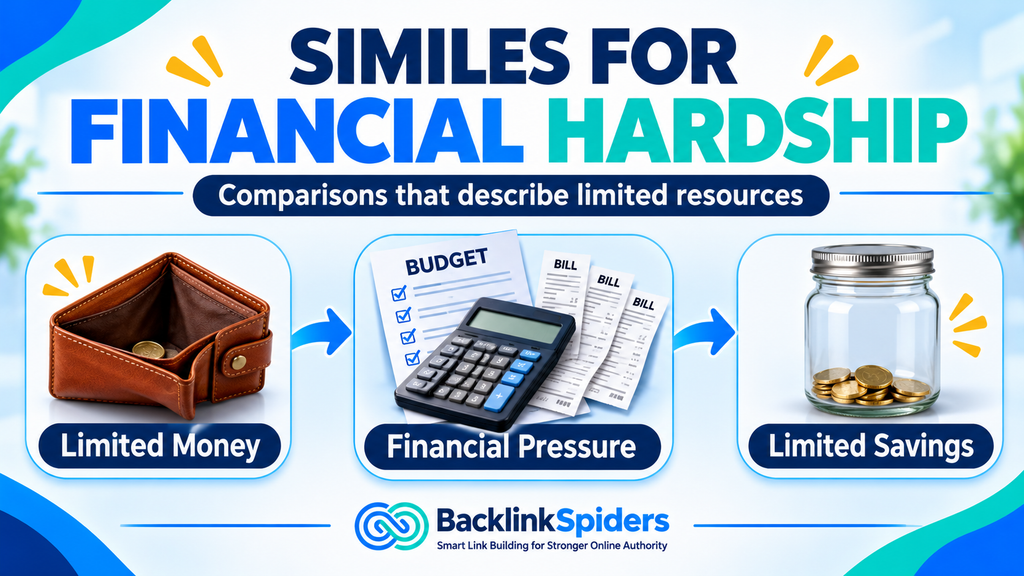
These examples focus on money, expenses, budgets, and the difficulty of meeting financial needs.
21. As short of money as a wallet without cash
Meaning: Having insufficient money for a purchase or expense.
Why it works: A wallet without cash is a familiar image of being unable to pay.
Example sentence: He was as short of money as a wallet without cash when the unexpected fee arrived.
22. Like a budget stretched as thin as thread
Meaning: Having a budget with very little room for additional expenses.
Why it works: Thin thread can break easily, suggesting that even a small extra expense may create difficulty.
Example sentence: Their monthly budget was like a thread stretched too thin after the rent increase.
23. As fragile as a glass savings jar
Meaning: Having financial security that could easily be affected by an unexpected expense.
Why it works: Glass can break under pressure, making it a useful image for vulnerable savings.
Example sentence: Her emergency savings were as fragile as a glass savings jar after the car repair.
24. Like a leaking bucket
Meaning: Losing money faster than it can be saved.
Why it works: A leaking bucket cannot hold all the water poured into it, just as repeated expenses can prevent savings from growing.
Example sentence: Their household budget was like a leaking bucket because every small saving was followed by another expense.
25. As limited as a single coin
Meaning: Having very little money available.
Why it works: One coin represents a small amount of money, especially when compared with larger expenses.
Example sentence: His spending money was as limited as a single coin until payday.
26. Like a bridge built from borrowed wood
Meaning: Depending on temporary or borrowed resources to manage a difficult situation.
Why it works: A bridge made from borrowed materials suggests that the support is limited and may not last.
Example sentence: The family’s financial plan was like a bridge built from borrowed wood as they waited for more stable income.
27. As burdened as a cart carrying stones
Meaning: Facing financial pressure from many expenses.
Why it works: A cart carrying heavy stones moves with difficulty, creating a clear image of a burden.
Example sentence: The household was as burdened as a cart carrying stones while managing several overdue bills.
28. Like a clock running on its last battery
Meaning: Having resources that are almost exhausted.
Why it works: A clock with a nearly depleted battery may stop working soon, suggesting that little remains.
Example sentence: Their savings were like a clock running on its last battery after months of unemployment.
29. As stretched as a rubber band pulled too far
Meaning: Having finances under considerable pressure.
Why it works: A rubber band stretched too far may snap, making it an effective image for a budget with little flexibility.
Example sentence: Their monthly finances were as stretched as a rubber band pulled too far.
30. Like a purse with a hole in the bottom
Meaning: Having difficulty keeping money because expenses continually consume it.
Why it works: Money placed in a purse with a hole does not stay there, creating a clear comparison with repeated spending.
Example sentence: His paycheck felt like a purse with a hole in the bottom because unexpected expenses kept appearing.
Similes for Having Few Resources
These comparisons describe limited supplies, difficult circumstances, and the challenge of making the most of what is available.
31. As empty as a pantry before harvest
Meaning: Having very few food supplies.
Why it works: A pantry before harvest may contain little because new supplies have not yet arrived.
Example sentence: Their pantry was as empty as a pantry before harvest while they waited for the next delivery.
32. Like a lamp running out of oil
Meaning: Having resources that are gradually disappearing.
Why it works: A lamp needs oil to keep burning, so the comparison suggests that support or supplies are running low.
Example sentence: The community’s funding was like a lamp running out of oil as the project continued.
33. As sparse as stars on a cloudy night
Meaning: Having very few things available.
Why it works: Clouds hide many stars, creating an image of limited visibility and scarcity.
Example sentence: Job opportunities in the small town were as sparse as stars on a cloudy night.
34. Like a bookshelf with only one book
Meaning: Having very few possessions, supplies, or choices.
Why it works: A bookshelf usually holds many books, so one book emphasizes how little is available.
Example sentence: The classroom’s resources were like a bookshelf with only one book.
35. As bare as a room without furniture
Meaning: Having very few possessions or material resources.
Why it works: An unfurnished room creates a simple and understandable image of emptiness.
Example sentence: Their new home was as bare as a room without furniture before they could afford the essentials.
36. Like a garden growing in cracked soil
Meaning: Trying to develop or succeed while facing difficult conditions.
Why it works: Cracked soil makes growth difficult, just as limited resources can make progress challenging.
Example sentence: The small organization was like a garden growing in cracked soil as it tried to serve the community with limited funding.
37. As small as a drop in a bucket
Meaning: Having an amount that is very small compared with what is needed.
Why it works: One drop is insignificant when compared with a full bucket.
Example sentence: The money they had saved was as small as a drop in a bucket compared with the cost of repairs.
38. Like a toolbox missing its tools
Meaning: Lacking the resources needed to complete a task.
Why it works: A toolbox without tools cannot serve its purpose, making the comparison useful for describing limited equipment or supplies.
Example sentence: The workshop was like a toolbox missing its tools because it lacked the equipment needed for the job.
39. As distant as an oasis in a desert
Meaning: Having access to help or resources that seems difficult to reach.
Why it works: An oasis may provide relief in a desert, but finding one can be difficult.
Example sentence: Reliable financial assistance felt as distant as an oasis in a desert during that difficult period.
40. Like a seed waiting for fertile ground
Meaning: Having potential but lacking the resources or conditions needed to grow.
Why it works: A seed needs suitable soil and care to develop, just as a person or project may need support and opportunity.
Example sentence: The young entrepreneur was like a seed waiting for fertile ground while searching for funding.
Powerful and Descriptive Similes for Poor
These comparisons are useful for stories, essays, and descriptive writing that explores the effects of financial hardship.
41. As vulnerable as a house without a roof
Meaning: Facing difficulties because essential protection or resources are missing.
Why it works: A house without a roof cannot provide complete shelter, creating an image of vulnerability.
Example sentence: Without reliable housing, the family felt as vulnerable as a house without a roof during a storm.
42. Like a road with no signposts
Meaning: Facing uncertainty while trying to find a way forward.
Why it works: A road without signposts makes it difficult to know which direction to take.
Example sentence: Managing the unexpected expenses was like traveling along a road with no signposts.
43. As uncertain as a boat in rough water
Meaning: Experiencing instability or uncertainty because resources are limited.
Why it works: Rough water makes a boat difficult to control, creating an image of financial instability.
Example sentence: Their financial situation was as uncertain as a boat in rough water after the unexpected job loss.
44. Like a tree growing against the wind
Meaning: Trying to make progress while facing difficult circumstances.
Why it works: A tree growing against strong wind must withstand pressure, making it a useful image of persistence under challenging conditions.
Example sentence: The family was like a tree growing against the wind as they worked through a difficult financial year.
45. As hopeful as a sunrise after a long night
Meaning: Finding hope after a period of hardship.
Why it works: A sunrise represents the arrival of a new day after darkness, making it a positive comparison for improving circumstances.
Example sentence: The new employment opportunity felt as hopeful as a sunrise after a long night.
Quick-Reference Table: Similes for Poor
Use this table to find a comparison quickly.
| Simile | Meaning | Best Used For |
|---|---|---|
| As poor as a church mouse | Having very little money | Simple descriptions |
| As empty as a dry well | Having no resources | Financial hardship |
| As bare as an empty cupboard | Having few supplies | Limited necessities |
| Like a candle burning at its last inch | Resources nearly exhausted | Savings or funding |
| As scarce as water in a desert | Resources difficult to find | Money or support |
| Like a leaking bucket | Money continually disappearing | Expenses |
| As stretched as a rubber band pulled too far | Finances under pressure | Household budgets |
| Like a garden growing in cracked soil | Progress under difficult conditions | Stories and essays |
| As small as a drop in a bucket | An amount too small for the need | Limited funding |
| As hopeful as a sunrise after a long night | Hope after hardship | Positive endings |
How to Use Similes for Poor in Writing
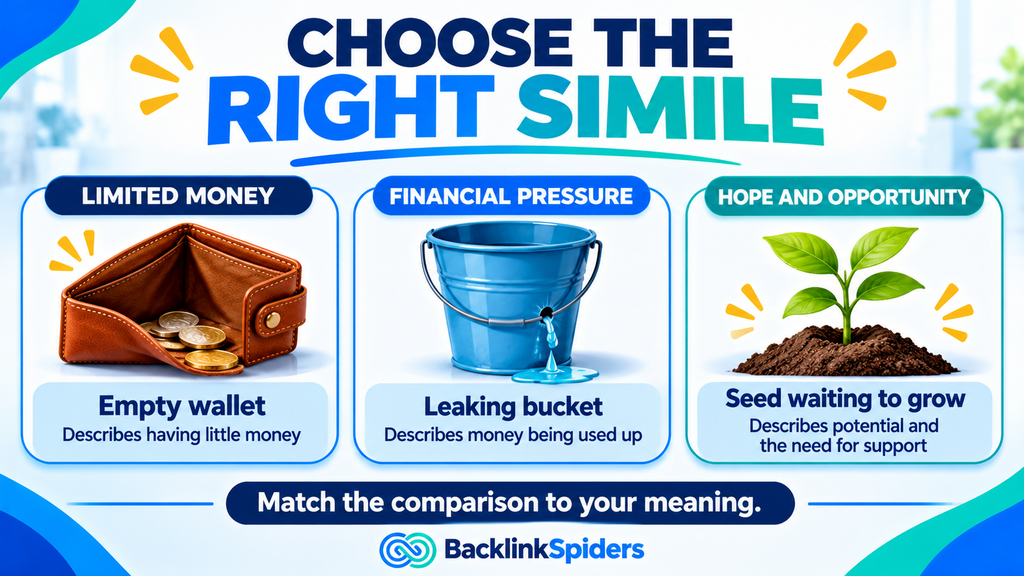
The best simile depends on what you want readers to understand.
A comparison about an empty wallet communicates something different from a comparison about a garden struggling to grow. One focuses on money, while the other suggests difficult conditions and limited opportunities.
1. Use Simple Similes for School Assignments
Simple comparisons are easy to understand and work well in basic descriptive writing.
Example:
The boy’s wallet was as empty as a dry well.
This sentence gives readers a clear picture of having no money without requiring a complicated explanation.
2. Use Financial Similes for Essays
When writing about financial hardship, choose comparisons that explain the situation rather than judging people.
Example:
The family’s budget was like a leaking bucket, with unexpected expenses consuming every small saving.
This comparison communicates the difficulty of maintaining financial stability.
3. Use Creative Similes for Stories
Creative comparisons can help establish atmosphere and show how difficult circumstances affect a character’s surroundings.
Example:
The little shop stood like a garden waiting for rain, its shelves quiet and its customers few.
This comparison describes the shop’s economic difficulties through an image of waiting and scarcity.
4. Use Hopeful Similes for Positive Endings
A story about financial hardship does not always need to end with another image of emptiness.
A hopeful comparison can show that circumstances may change.
Example:
After months of uncertainty, the new job arrived like a sunrise after a long night.
The comparison creates a sense of relief and renewed possibility.
5. Choose Comparisons That Match the Situation
| Writing Purpose | Suitable Simile |
|---|---|
| Describe having no money | As empty as a dry well |
| Explain a limited budget | As stretched as a rubber band pulled too far |
| Describe missing supplies | Like a cupboard with one lonely can |
| Show difficult circumstances | Like a garden growing in cracked soil |
| Describe financial uncertainty | As uncertain as a boat in rough water |
| End a story positively | As hopeful as a sunrise after a long night |
How to Create Your Own Similes for Poor
You can create an original simile by identifying the situation and choosing an image that communicates it clearly.
Step 1: Identify the specific meaning
Decide whether you want to describe:
- Having no money
- Having limited food or supplies
- Struggling with expenses
- Facing uncertainty
- Lacking opportunities
- Finding hope after hardship
Step 2: Choose a familiar image
Think about objects or situations that naturally suggest the same idea.
For example:
- An empty wallet suggests having no money.
- A dry well suggests scarcity.
- A leaking bucket suggests resources disappearing.
- A seed without soil suggests potential without support.
Step 3: Connect the two ideas
Use like or as to make the comparison.
Plain sentence: The family had very little money.
Simile: The family’s savings were like a small candle burning near the end.
Step 4: Check whether the comparison makes sense
Ask yourself:
- Is the image easy to understand?
- Does it describe the intended situation?
- Does it sound natural?
- Is it respectful?
- Does it add something to the sentence?
If the comparison feels confusing or insulting, choose a clearer one.
Common Mistakes When Using Similes for Poor
1. Confusing Poverty With Personal Worth
Financial hardship describes a person’s circumstances, not their character or value.
Avoid comparisons that suggest people experiencing poverty are inherently inferior, lazy, or foolish.
Instead, describe the specific situation.
Better: The family’s budget was as tight as a knot.
This describes financial pressure without judging the family.
2. Choosing an Image That Does Not Match the Meaning
A comparison should communicate the intended idea.
For example, a simile about a tree growing against the wind describes difficulty and resistance. It does not directly mean having no money.
Use it when the sentence focuses on facing challenges rather than simply describing an empty wallet.
3. Using Too Many Similes in One Sentence
Several comparisons together can make writing confusing.
Overloaded: His wallet was like a dry well, an empty cupboard, a broken bucket, and a desert without rain.
Better: His wallet was as empty as a dry well.
One clear comparison usually communicates the idea more effectively.
4. Repeating the Same Image
If every simile involves an empty wallet or cupboard, the article or story may feel repetitive.
Use different images for different purposes:
- Wallets for money
- Cupboards for supplies
- Buckets for ongoing expenses
- Gardens for growth and opportunity
- Boats for uncertainty
This makes the writing more varied and precise.
5. Using Negative Comparisons When a Neutral Description Is Better
Not every discussion of poverty needs figurative language.
For academic writing, a direct sentence may be clearer.
Direct: The household had insufficient income to cover its essential expenses.
Figurative: The household’s budget was like a leaking bucket.
Both can be useful, but the direct version may be more appropriate when precision matters.
Frequently Asked Questions
1. What is a good simile for poor?
A good simile is “as empty as a dry well.” It describes having very little money or few available resources. The comparison is easy to understand because a dry well contains no water, making it a clear image of scarcity.
2. What is a simple simile for poor for students?
“As empty as an empty wallet” is a simple comparison for having no money.
Example: After buying the school supplies, his wallet was as empty as an empty wallet.
For a more natural sentence, you can write: “His wallet was empty like a pocket with no coins.”
3. What is a creative simile for financial hardship?
“Their budget was like a leaking bucket.”
This comparison suggests that money was continually disappearing through expenses, making it difficult to save.
Example: Their budget was like a leaking bucket because every unexpected bill used up the money they had set aside.
4. What is a simile for having very little money?
“As poor as a church mouse” is a familiar expression for having very little money.
Example: After paying for rent and groceries, he felt as poor as a church mouse.
5. How can I describe poverty in a story using a simile?
Choose an image that reflects the specific circumstances.
For example:
“Their cupboard was as bare as a winter branch.”
This comparison emphasizes the lack of supplies.
You could also write:
“Their savings were like a candle burning at its last inch.”
That comparison focuses on resources that are almost exhausted.
6. What is a positive simile for someone experiencing financial hardship?
“As hopeful as a sunrise after a long night” is a positive comparison for someone looking toward better circumstances.
Example: The new opportunity made her feel as hopeful as a sunrise after a long night.
The comparison communicates hope without suggesting that financial hardship defines the person.
7. Can similes for poor be used in poems and essays?
Yes. Similes can make descriptive writing more vivid, but the best choice depends on the purpose.
In a poem or story, an image such as a dry riverbed may communicate scarcity.
In an academic essay, a direct explanation of income, resources, or economic conditions may be more appropriate.
Use figurative language when it improves clarity or creates a meaningful image.
Practice Questions: Similes for Poor
Test your understanding with these five exercises.
1. Complete the simile.
His wallet was as empty as a ______.
A. dry well
B. bright sunrise
C. full basket
2. Choose the best simile for a budget with many unexpected expenses.
A. Like a garden without seeds
B. Like a leaking bucket
C. As bright as the morning sun
3. What does this simile mean?
“Their savings were like a candle burning at its last inch.”
A. Their savings were growing quickly.
B. Their savings were almost exhausted.
C. Their savings were unlimited.
4. Complete the comparison.
The small organization was like a garden growing in ______.
A. cracked soil
B. clear water
C. bright sunlight
5. Write your own simile.
Complete the sentence:
“The family’s financial situation was like ______.”
Choose an image that communicates limited resources, uncertainty, or difficulty.
Practice Answers
- A. Dry well — A dry well suggests that no money or resources remain.
- B. Like a leaking bucket — The comparison describes money continually disappearing through expenses.
- B. Their savings were almost exhausted.
- A. Cracked soil — The comparison suggests that progress is difficult because conditions are challenging.
- Example answer: The family’s financial situation was like a boat in rough water.
Other answers are acceptable if the comparison makes sense and communicates the intended meaning.
Explore More Similes
Final Thoughts
These 45 similes for poor provide different ways to describe financial hardship, limited resources, and difficult circumstances. Comparisons such as an empty wallet or dry well work well for simple descriptions, while images of leaking buckets, struggling gardens, and boats in rough water can add more detail to stories and essays.
The strongest simile is not necessarily the most complicated one. Choose an image that clearly communicates what you mean, fits the tone of your writing, and respects the people or circumstances being described.
You can also create your own comparisons by connecting familiar objects with the specific challenges you want readers to understand. A thoughtful simile makes an idea easier to picture without making the writing unnecessarily complicated.

The BacklinkSpiders editorial team writes and reviews every simile guide on the site, checking that each comparison is accurate, clearly explained and paired with natural example sentences.