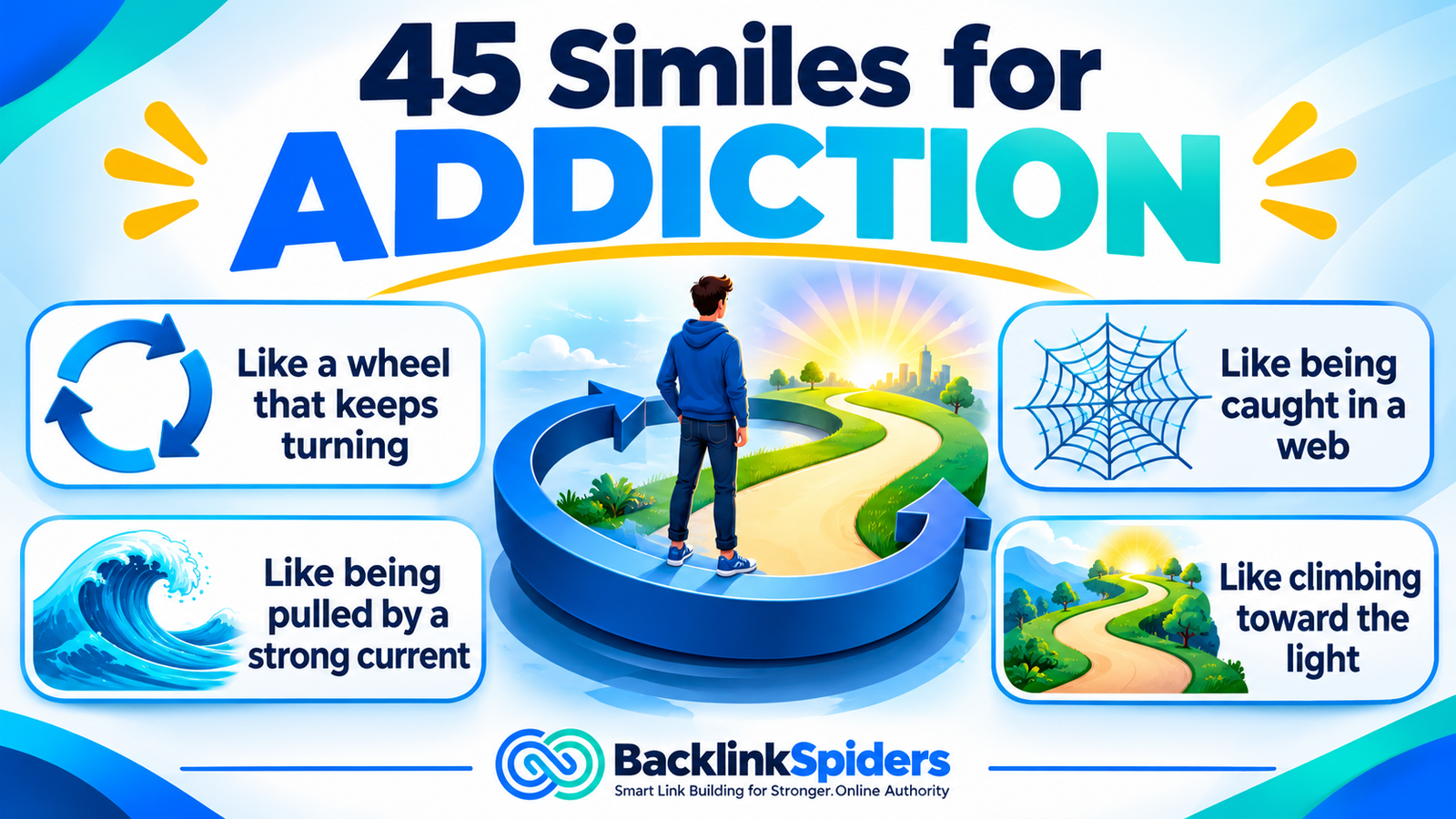
Addiction can be difficult to describe because it involves more than a repeated habit. It can affect a person’s choices, emotions, relationships, and everyday life. Similes can help communicate these complicated experiences through familiar images, such as a never-ending loop, a heavy burden, or a tangled knot.
These 45 similes for addiction explore dependency, compulsive behavior, emotional struggles, isolation, and the possibility of recovery. Each comparison includes a meaning and an example sentence to help you use it in essays, stories, poems, and descriptive writing. The examples approach addiction with sensitivity and avoid defining people by their struggles.
What Is a Simile for Addiction?
A simile for addiction compares the experience of dependency or compulsive behavior to something familiar using words such as like or as. It helps readers understand difficult feelings and experiences through descriptive language.
For example, “Addiction can feel like a never-ending loop” compares repetitive behavior to a cycle that is difficult to escape. Similarly, “Recovery is like finding a path through a dense forest” represents the challenges and possibilities involved in making positive changes.
These comparisons are literary descriptions, not medical definitions. Addiction is a complex health condition, and no single simile can represent everyone’s experience.
45 Similes for Addiction With Meanings and Examples
The following examples explore different aspects of addiction, from repetitive patterns and emotional difficulties to isolation, support, and recovery.
Similes for the Cycle of Addiction
These comparisons describe repetitive patterns and the difficulty of breaking away from compulsive behavior.
1. Like a never-ending loop
Meaning: A repeated pattern that feels difficult to break.
Example: His struggle with addiction felt like a never-ending loop, with the same challenges returning again and again.
2. Like a revolving door
Meaning: A repetitive cycle in which someone repeatedly returns to a familiar situation.
Example: Her experience felt like a revolving door, as old patterns kept interrupting her efforts to move forward.
3. Like running on a treadmill
Meaning: Making repeated efforts without feeling that meaningful progress is happening.
Example: He described the experience as like running on a treadmill, constantly trying but struggling to move ahead.
4. Like a wheel turning in the same place
Meaning: Being caught in repetitive behavior without reaching a different outcome.
Example: The repeated promises and disappointments felt like a wheel turning in the same place.
5. Like a maze without clear directions
Meaning: Feeling lost while trying to find a way out of a difficult situation.
Example: Understanding her situation felt like navigating a maze without clear directions.
6. Like a river trapped behind a dam
Meaning: Experiencing powerful internal pressures that seem unable to find a healthy outlet.
Example: His emotions felt like a river trapped behind a dam, building up without an easy way to express them.
7. Like a clock that keeps returning to the same hour
Meaning: Repeatedly experiencing the same difficulties despite wanting change.
Example: Every setback made the situation feel like a clock returning to the same hour.
8. Like a road with no visible exit
Meaning: Feeling trapped in a situation when a clear way forward is difficult to see.
Example: At that point, addiction seemed like a road with no visible exit.
9. Like waves returning to the shore
Meaning: Repeated difficulties that come back even after periods of calm.
Example: The challenges returned like waves reaching the shore, reminding him that progress could take time.
Similes for the Emotional Weight of Addiction
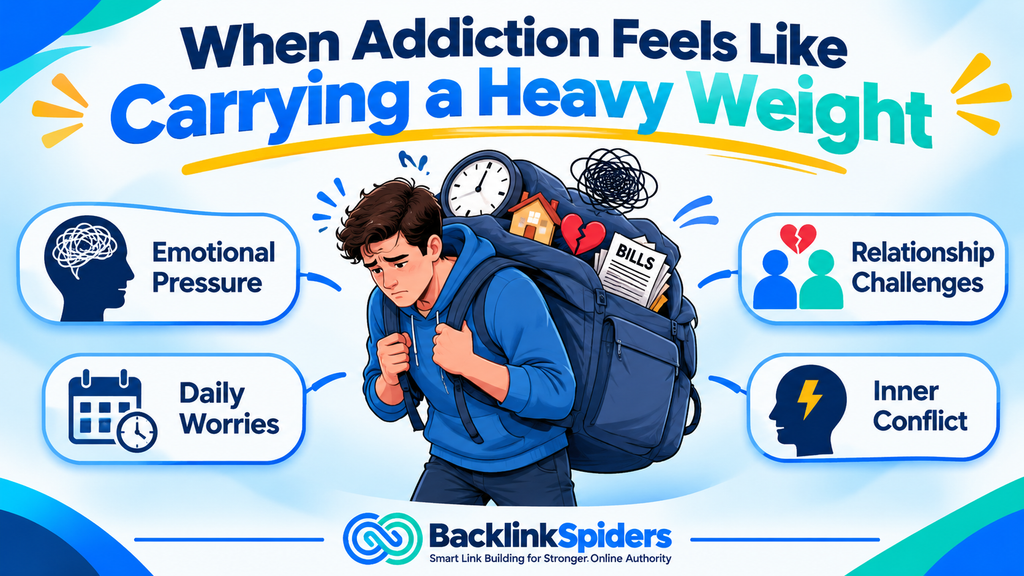
These comparisons focus on the emotional burden, uncertainty, and internal struggles that addiction can involve.
10. Like carrying a mountain on one’s shoulders
Meaning: Feeling overwhelmed by an extremely heavy emotional burden.
Example: The guilt and uncertainty felt like carrying a mountain on her shoulders.
11. Like a dark cloud following every step
Meaning: Experiencing persistent worry or emotional heaviness.
Example: The stress seemed like a dark cloud following every step he took.
12. Like a storm inside a quiet room
Meaning: Experiencing intense internal emotions while appearing calm externally.
Example: Although she remained quiet, her thoughts felt like a storm inside a quiet room.
13. Like a knot that grows tighter
Meaning: A difficult emotional situation that becomes increasingly complicated.
Example: The longer he avoided discussing his problems, the situation felt like a knot growing tighter.
14. Like walking through thick fog
Meaning: Feeling uncertain, confused, or unable to see a clear direction.
Example: Making everyday decisions felt like walking through thick fog.
15. Like a heavy shadow across a sunny day
Meaning: An emotional struggle that affects otherwise positive experiences.
Example: The ongoing difficulties felt like a heavy shadow across a sunny day.
16. Like a ship caught in rough waters
Meaning: Feeling emotionally unsettled and struggling to maintain stability.
Example: During that difficult period, his life felt like a ship caught in rough waters.
17. Like a candle struggling against the wind
Meaning: Trying to maintain hope during a difficult experience.
Example: Her determination was like a candle struggling against the wind, still shining despite the challenges.
18. Like a puzzle with missing pieces
Meaning: Feeling unable to understand how different problems and emotions fit together.
Example: His experience seemed like a puzzle with missing pieces.
Similes for Feeling Trapped or Isolated
These comparisons describe the loneliness, disconnection, and restricted sense of freedom that some people experience.
19. Like a bird behind a closed window
Meaning: Feeling restricted and unable to reach the freedom one wants.
Example: He sometimes felt like a bird behind a closed window, watching opportunities from a distance.
20. Like standing alone on an empty island
Meaning: Feeling separated from other people and lacking emotional connection.
Example: Despite being surrounded by others, she sometimes felt like someone standing alone on an empty island.
21. Like a door that refuses to open
Meaning: Feeling unable to move beyond a difficult situation.
Example: Every attempt to change seemed like knocking on a door that refused to open.
22. Like a room without windows
Meaning: Experiencing a lack of hope or perspective.
Example: His world felt like a room without windows when he could not imagine a different future.
23. Like a bird caught in a tangled net
Meaning: Feeling restricted by complicated circumstances.
Example: The combination of emotional and personal difficulties made her feel like a bird caught in a tangled net.
24. Like walking in circles inside a locked garden
Meaning: Repeatedly trying to find a solution while feeling restricted.
Example: His efforts sometimes felt like walking in circles inside a locked garden.
25. Like a lighthouse hidden by thick fog
Meaning: Having difficulty recognizing sources of guidance or support.
Example: During his hardest days, helpful advice seemed like a lighthouse hidden by thick fog.
26. Like a voice lost in a crowded room
Meaning: Feeling unheard or unable to communicate personal struggles.
Example: She felt like a voice lost in a crowded room whenever she tried to explain her difficulties.
27. Like a bridge covered in mist
Meaning: Seeing a possible way forward but feeling uncertain about reaching it.
Example: The road toward change seemed like a bridge covered in mist.
Similes for the Impact of Addiction on Daily Life
These comparisons can help writers describe how addiction may affect routines, relationships, responsibilities, and personal goals.
28. Like a crack spreading across glass
Meaning: A problem that gradually affects different areas of life.
Example: The consequences became like a crack spreading across glass, gradually affecting his relationships and responsibilities.
29. Like an unwanted guest who never leaves
Meaning: A persistent problem that continues to interfere with everyday life.
Example: The struggle felt like an unwanted guest who never leaves.
30. Like a stone dropped into still water
Meaning: An event that creates consequences extending beyond the original situation.
Example: The family’s discovery of the problem was like a stone dropped into still water, affecting everyone around them.
31. Like a thread unraveling from a sweater
Meaning: A situation in which one difficulty gradually affects other parts of life.
Example: The disruption to his daily routine felt like a thread unraveling from a sweater.
32. Like a clock losing its rhythm
Meaning: Losing a sense of routine, consistency, or balance.
Example: His daily schedule became like a clock losing its rhythm as responsibilities became harder to manage.
33. Like a garden left without care
Meaning: Personal goals and relationships gradually receiving less attention.
Example: Her neglected interests felt like a garden left without care.
34. Like a bridge weakened by repeated storms
Meaning: Relationships becoming strained after repeated difficulties.
Example: Their friendship felt like a bridge weakened by repeated storms, needing patience and attention to rebuild trust.
35. Like a book with pages torn out
Meaning: Feeling that important experiences or opportunities have been lost or disrupted.
Example: Looking back at those difficult years felt like reading a book with pages torn out.
Similes for Hope, Support, and Recovery
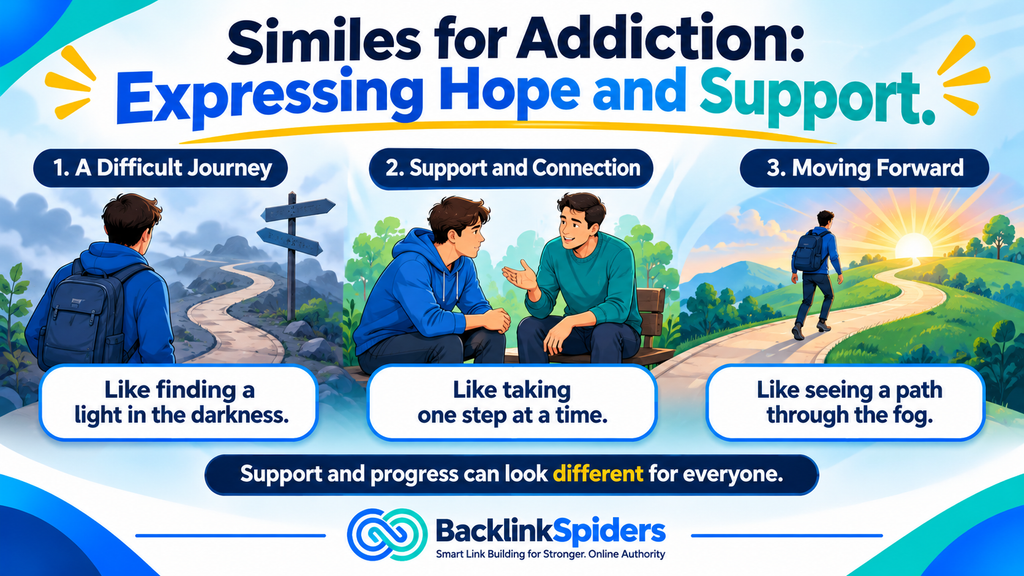
These comparisons focus on encouragement, gradual progress, and the importance of support. Recovery does not follow one identical path for everyone.
36. Like finding a path through a dense forest
Meaning: Gradually discovering a way forward through a complicated experience.
Example: With support and patience, recovery began to feel like finding a path through a dense forest.
37. Like sunrise after a long night
Meaning: Experiencing renewed hope after a difficult period.
Example: Her first meaningful step toward recovery felt like sunrise after a long night.
38. Like a seed growing through the soil
Meaning: Making gradual progress even when the results are not immediately visible.
Example: His progress was like a seed growing through the soil, developing quietly over time.
39. Like rebuilding a house one brick at a time
Meaning: Making steady improvements through small, consistent efforts.
Example: Rebuilding trust was like rebuilding a house one brick at a time.
40. Like a lighthouse guiding ships through darkness
Meaning: Receiving guidance and encouragement during a difficult experience.
Example: Her supportive friends were like a lighthouse guiding ships through darkness.
41. Like a bridge connecting two distant shores
Meaning: Support helping someone move from a difficult situation toward a more hopeful future.
Example: Professional support became like a bridge connecting two distant shores.
42. Like fresh air entering a closed room
Meaning: Experiencing relief, clarity, or renewed hope.
Example: Talking openly about his struggles felt like fresh air entering a closed room.
43. Like learning to walk on a new path
Meaning: Gradually developing new routines and ways of responding to challenges.
Example: Building healthier habits was like learning to walk on a new path.
44. Like a broken compass finding its direction
Meaning: Gradually regaining a sense of purpose after feeling lost.
Example: With encouragement, she felt like a broken compass slowly finding its direction.
45. Like a garden blooming after the rain
Meaning: Experiencing renewed growth and hope after a difficult period.
Example: His renewed interest in life was like a garden blooming after the rain.
Quick-Reference Table: Best Similes for Addiction
| Simile | Meaning | Best Used For |
|---|---|---|
| Like a never-ending loop | Repeated patterns | Dependency |
| Like running on a treadmill | Effort without progress | Frustration |
| Like carrying a mountain | Heavy emotional burden | Emotional struggles |
| Like walking through thick fog | Uncertainty | Confusion |
| Like a bird behind a closed window | Restricted freedom | Feeling trapped |
| Like a crack spreading across glass | Gradual consequences | Life changes |
| Like a bridge weakened by storms | Strained relationships | Family difficulties |
| Like sunrise after a long night | Renewed hope | Recovery |
| Like a seed growing through soil | Gradual progress | Personal growth |
| Like a lighthouse in darkness | Guidance and support | Encouragement |
How to Use Similes for Addiction in Writing
When writing about addiction, choose comparisons that communicate the experience without reducing a person to a stereotype. The most effective similes focus on feelings, challenges, relationships, and changes over time.
1. Describe Repetitive Behavior
Comparisons involving loops, revolving doors, and circular paths can communicate repetitive patterns.
Plain sentence:
He kept returning to the same difficult behavior.
Improved sentence:
His experience felt like a revolving door, with familiar challenges appearing again and again.
The comparison makes the repetitive nature of the situation easier to visualize.
2. Express Emotional Struggles
Use images such as storms, fog, heavy clouds, and tangled knots to communicate difficult feelings.
Example:
Although he rarely discussed his problems, his thoughts felt like a storm inside a quiet room.
This sentence contrasts his outward appearance with his internal experience.
3. Show the Effects on Relationships
Comparisons involving weakened bridges, spreading cracks, and neglected gardens can describe the effects of prolonged difficulties on relationships.
Example:
Their relationship felt like a bridge weakened by repeated storms, but both were willing to work toward rebuilding trust.
4. Describe Hope and Recovery
Use positive comparisons carefully to communicate the possibility of change without suggesting that recovery is always easy or predictable.
Example:
Her progress was like a seed growing through the soil, developing gradually with patience and support.
This comparison emphasizes gradual improvement rather than an instant transformation.
5. Use Similes in Poems and Stories
Similes can help communicate complex emotions without explaining every detail.
For example:
“Through endless nights of doubt and rain,
A path appeared beyond the pain.”
In creative writing, imagery can help readers connect with a character’s experiences while maintaining a respectful tone.
How to Create Your Own Similes for Addiction
You can create original comparisons by identifying a particular experience and connecting it with a familiar image.
Follow these steps:
- Identify the experience: Is the character feeling trapped, overwhelmed, isolated, uncertain, or hopeful?
- Choose a meaningful image: Consider a tangled knot, a storm, a winding road, a growing plant, or a lighthouse.
- Build the comparison: Connect the two ideas using like or as.
For example:
- Experience: Feeling trapped in a repeated pattern.
- Image: A road that keeps returning to its starting point.
- Original simile: “The struggle felt like a winding road that always returned to the same crossroads.”
The result is a descriptive comparison that communicates the experience without judging the person.
Frequently Asked Questions
1. What is a good simile for addiction?
“Like a never-ending loop” is a useful simile for addiction because it represents repetitive patterns that can be difficult to break. It can describe the feeling of repeatedly facing similar challenges.
2. What is a powerful simile for addiction?
“Like carrying a mountain on one’s shoulders” is a powerful comparison for the emotional burden associated with addiction. It communicates the feeling of being overwhelmed by difficult circumstances.
3. How do you describe addiction using figurative language?
You can describe addiction using comparisons involving cycles, tangled knots, heavy burdens, or difficult journeys. For example, “The struggle felt like walking through thick fog” communicates uncertainty and difficulty finding direction.
4. What is a simile for feeling trapped by addiction?
“Like a bird behind a closed window” is a descriptive simile for feeling restricted or unable to reach the freedom one wants.
5. What is a positive simile for addiction recovery?
“Like sunrise after a long night” is a hopeful comparison for recovery. It represents renewed hope after a difficult period without suggesting that everyone’s experience follows the same path.
6. Can similes about addiction be used in poems and stories?
Yes. Writers can use similes to communicate emotional struggles, repeated patterns, isolation, relationships, and recovery. Thoughtful comparisons make sensitive subjects more understandable and memorable.
7. What is the difference between a simile for addiction and a metaphor for addiction?
A simile compares two different things using words such as like or as. A metaphor describes one thing as another without using those comparison words. For example, “Addiction is like a tangled knot” is a simile, while “Addiction is a tangled knot” is a metaphor.
Explore More Similes
Final Thoughts
Similes for addiction can help writers describe dependency, emotional difficulties, isolation, strained relationships, and the possibility of recovery. Comparisons such as “like a never-ending loop,” “like carrying a mountain on one’s shoulders,” and “like sunrise after a long night” communicate different aspects of this complex experience.
Choose comparisons that match the situation and the emotions being described. Avoid language that blames or labels people experiencing addiction. Thoughtful figurative language can make difficult subjects easier to understand while preserving the dignity of the people involved.

The BacklinkSpiders editorial team writes and reviews every simile guide on the site, checking that each comparison is accurate, clearly explained and paired with natural example sentences.